Emotion-First Curation: Diving Deep into the Soul of a Painting
Part II: The Moment After - The Big Splash

If Matisse asks us to stay, David Hockney gives us almost no time at all.
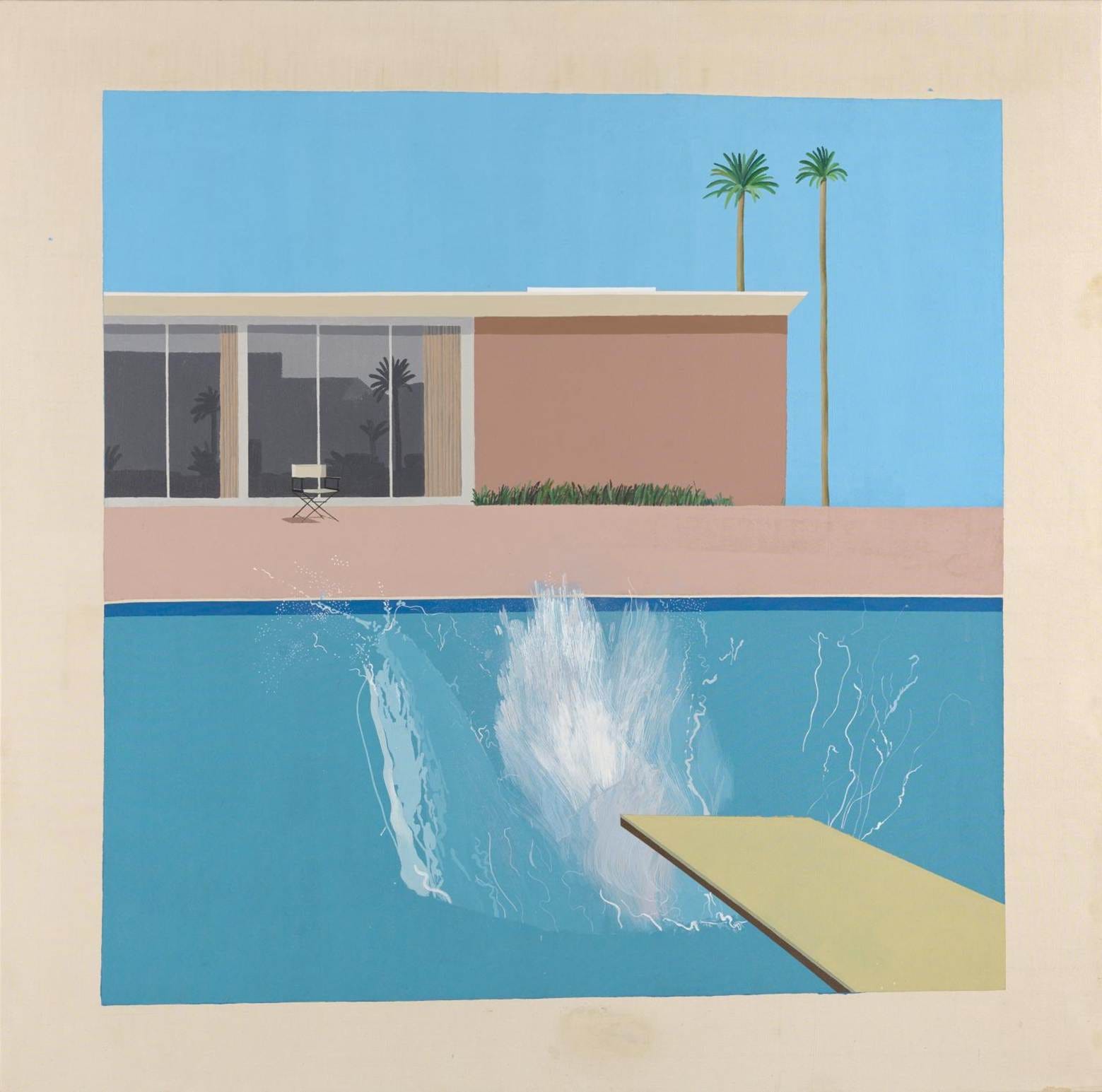
The Big Splash captures a fraction of a second. A burst of water erupts in a pristine California pool. The diver is gone. The cause has already disappeared. What remains is evidence, not action.
The painting does not ease us in.
It confronts us with aftermath.
Painted in 1967, The Big Splash is clean, bright, and sharply edged. A low modern building sits calmly behind the pool. A palm tree rises into a cloudless sky. Everything is composed, controlled, sunlit. And yet, at the center of this order, the splash interrupts it. White against blue. Energy without a body.
We arrive too late to see what happened.
That delay matters.
Unlike Matisse’s studio, which allows us to remain inside a sustained state of thought, Hockney’s pool places us just outside the event. We are not given the action itself, only its consequence. The painting asks us to reconstruct the moment from fragments. To imagine the body that has already exited the frame. To mentally complete a gesture that has been withheld.
Absence becomes the engine of the work.
The splash feels dramatic, but the painting itself is strangely quiet. There is no figure to follow, no expression to interpret, no story made explicit. The water will settle. The surface will return to calm. Whatever happened here has already passed, and we are left with only a trace.
This changes how emotion enters the picture.
We do not feel this painting by inhabiting it.
We feel it by supplying what is missing.
The act of looking becomes an act of reconstruction. Our attention moves backward in time, filling in what the image refuses to show us. The painting holds still, while our minds do the work.
Hockney understood this tension well. Born in England in 1937 and drawn early to the visual language of Los Angeles, he was deeply attentive to surfaces, to visibility, to moments that appear effortless but are carefully staged. In The Big Splash, clarity and control coexist with sudden disruption. The setting promises ease. The interruption suggests something less settled.
What we are left with is not a person, but a disturbance.
And that disturbance lingers.
Today, The Big Splash hangs at the Tate in London, far from the California pool it depicts. That distance feels fitting. The painting has always been about looking at a moment after it has passed, about reconstructing experience from what remains. Seen from across the ocean, the pool becomes less a place than an idea, shaped as much by memory and imagination as by geography.
Seen this way, The Big Splash becomes less about spectacle and more about how meaning travels through absence. We learn by inference, by proximity, by what lingers once the action is gone. This is true not only of paintings, but of people. Artistic influence rarely arrives fully formed or neatly documented. It moves through conversations, friendships, and shared ways of seeing overtime. Often, it is felt more than recorded. It is this quieter kind of influence that comes into focus next, through the voice of Liz de Souza, as she reflects on her father, M. Bunch Washington, and his enduring friendship with Romare Bearden.